Posts Tagged ‘pool’

According to Plymouth Magazine- Two Must-Try Green Products

July 15th, 2011

Creative Water Solutions  has been recognized by Plymouth Magazine for having two must-try green products.  The article features the city of Plymouth and the plethora of sustainable services, businesses and initiatives it has to offer. The six part series showcases the local green movement. Read more at Plymouth Magazine.

Summer is on its Way! Water Safety Recommendations

May 19th, 2011

During the summer months, there’s nothing better for adults and kids alike than taking a dip in a nice, cool swimming pool, lake, or river. Summer is also when we head to the lake and rivers with our boats, jet skis, kayaks, etc.

Yet, as we know from recent events, water fun can swiftly become tragedy if some simple, basic safety rules aren’t observed. Make sure you and your family are water safe by following these safety policies:

home_poolBASIC WATER SAFETY

Learn to swim

The best thing anyone can do to stay safe in and around the water is to learn to swim. The American Red Cross has swimming courses for people of any age and swimming ability.

Learn CPR and insist that babysitters, grandparents, and others who care for your child know CPR. The American Red Cross and the Minnesota National Safety Council both offer CPR classes.

Never leave a child unobserved around water—any water, including pools, spas, bath tubs, etc. Adult eyes must be on children at all times when around water.  The average child stays on the surface of the water for only 10 seconds and the drowning process can start after they are submerged within 20 seconds.

It takes as little as 2 inches of water and 2 minutes for a child to drown. Toilets and buckets of water can be deadly to toddlers, who are top-heavy and can fall over head first. If you have toddlers in your home, always keep the toilet seat down and never leave a bucket of water unattended.

Always swim with a buddy; never swim alone, even in your own pool.

Wear a lifejacket or PFD whenever possible, the Personal Floatation Device must be US Coastguard approved and fit properly.

Don’t swim if you’re under the influence of alcohol or other drugs.

POOL SAFETY

Make sure the depths of your pool are clearly marked. Teach children and other inexperienced or non-swimmers to stay in the shallow end.

Post CPR instructions in the pool area.

If you have a cordless (not cell) phone, keep it with you at the pool. If there is any pool emergency, call 911 IMMEDIATELY; then attempt rescue efforts.

Always keep basic lifesaving equipment by the pool and know how to use it. Pole, rope, and personal flotation devices are recommended.

Enclose the pool completely with a self-locking, self-closing fence with vertical bars. Openings in the fence should be no more than four inches wide. The house should not be included as a part of the barrier.

Pool covers should always be completely removed prior to pool use.

Consider installing an alarm that will sound if anyone or anything falls in the pool. Remember: A child can drown in less than two minutes.
Never leave furniture near the fence that would enable a child to climb over the fence.

Keep toys away from the pool when it is not in use. Toys can attract young children into the pool.

If a child is missing, check the pool first. Go to the edge of the pool and scan the entire pool, bottom, and surface, as well as the surrounding pool area. Keep your pool water sparkling clean so if someone is on the bottom, they can be seen.

Make sure your pool deck is made of or treated with slip-resistant materials.

In public swimming pools, always swim in areas supervised by a lifeguard and read and obey all rules and posted signs.

LAKE & RIVER SAFETY

Children or inexperienced swimmers should ALWAYS wear a US Coast Guard-approved personal floatation device/life jacket when around the water.

Watch out for the dangerous “too’s” – too tired, too cold, too far from safety, too much sun, too much strenuous activity.

Set water safety rules for the whole family based on swimming abilities (for example, inexperienced swimmers should stay in water less than chest deep).

Be knowledgeable of the water environment you are in and its potential hazards, such as deep and shallow areas, currents, depth charges, obstructions and where the entry and exit points are located. The more informed you are, the less likely you are to be injured or killed.

Use a feet-first entry when entering the water.

Opening your pool this summer the PoolNaturally® way!

April 21st, 2011

If you are a new or returning PoolNaturally® user, here are our suggestions for a more natural pool opening:

Spring Start Up/Opening

Install the PoolNaturally® system at the beginning of the pool season for best results, but better late than never!  Returning PoolNaturally users report much easier pool start up the following summer.  Excellent opening results are seen even if users installed PoolNaturally as late as August of the last pool season.  

Start with a fresh filter

Remove filter media (sand, DE) and replace with fresh media if you are just starting the PoolNaturally system. If you have a cartridge filter, for best results replace it or please ensure the cartridge is well cleaned.  Why?  If you are new to PoolNaturally, your pool has years of accumulation of biofilm and the filter will contain a large amount of it.  The easiest way to get rid of much of it fast is to change out the media or replace the cartridge filter.

If you used PoolNaturally last season, be sure to backwash the sand filter after filling your pool with water.  Place cleaned or new cartridge filters back in the system. 

Less is more!

When starting/opening your pool, know what you are putting in it!  If you used PoolNaturally last summer, don’t start by adding shock, algaecides and cyanuric acid.  Expect that your pool will start up with a minimum amount of additives.

-Add chlorine to get desired free chlorine.

-Adjust pH, alkalinity, hardness , and CYA to recommended levels below:

  • Free chlorine     1-2 ppm
  • pH          7.2-7.6
  • Alkalinity              40-120
  • Hardness             200-300
  • CYA                        *less than 20 ppm

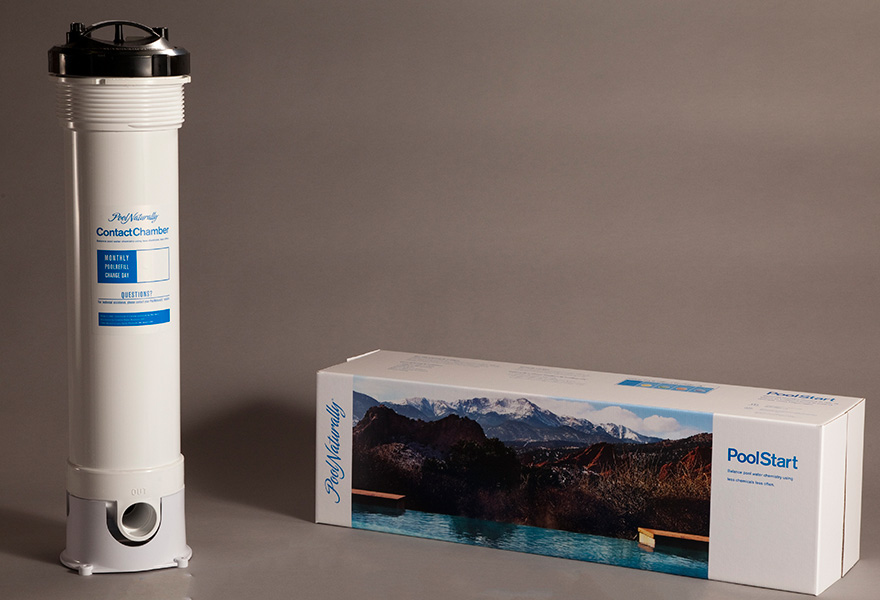
-Once water has been balanced, add PoolNaturally® PoolRefills to PoolNaturally® contact chamber according to the dosage chart below.  It is important that once there is enough water in your pool to start the pumps, get it balanced and add PoolRefills as soon as possible, to begin experiencing the conditioning effects of moss.

 Pool Size Chart 2011small

How Your Pool Will Change With PoolNaturally

Depending on the age and how much your pool is used, there could be a lot of material (including scale) that is shed from the pipes, pumps, heater, and pool surfaces – this is evidence that the PoolNaturally system is working!  Use a pool vacuum to get rid of the larger particles that settle out in the pool and clean or backwash filters to get rid of the smaller particles.

Maintain 1-2 ppm of chlorine – you won’t need anything higher.  With PoolNaturally, your pool is no longer precariously on the edge of ‘going bad.’  It will take less chlorine to maintain this 1-2 ppm free available chlorine, so turn down your automatic chlorinator or salt generator to the lowest settings.

Go Greener: Tips for “going green” in your backyard

September 8th, 2010

greenideas2Cover up

covers prevent both water & chemical loss from evaporation

Reuse the water

use drained pool/spa water to irrigate your lawn (just remember don’t add any chemicals 3 days prior to draining)

Go solar-

by going large scale (direct solar panels) or small scale (accent lights) the devices will pay off when it comes time to pay the electric bill

Make it recycled-

Thinking of revamping the backyard? Look into recycled products: cabinets, patio furniture, and fencing are just a few of the products you can get from recycled material. They are low maintenance and made to last for a while

Lower temperature, more saving -

by lowering the temperature of your spa 3 degrees while it not being used can save you 5-10% of your spa heating cost

Biofilm, Medical Devices, Your Pool or Spa

July 20th, 2009

Last week we talked about biofilm, the microscopic colony of bacteria that lives where water, bacteria and any surface meet.  Scientists who study bacteria in the laboratory have known about biofilm for 10-15 years.  It has taken that long for the laboratory bench research to impact our daily lives and biofilm impacts just about everything.  Think about it:  combine water, a surface and bacteria and you have instant biofilm.

Biofilm: A Slime City

A recent article in the July/August 2009 issue of Discover by Wendy Orent called “Slime City” talked about biofilm and its impact on medicine and implanted medical devices.  She did a great job describing what is known about biofilm and how it causes serious diseases and problems in the body. View the article:  http://discovermagazine.com/2009/jul-aug/17-slime-city-germs-talk-each-other-plan-attacks/?searchterm=Slime

The same biofilm that coats medical devices, your teeth, or an infected bone or wound covers every surface of your pool or spa.  All disinfectants such as chlorine, bromine, ozone, cooper or silver are effective killers of bacteria that swim in the water.  Unfortunately, that’s only 1-2% of the bacteria that populate a pool or spa.  The rest are safely protected from the disinfectants by biofilm.

The colony in biofilm is static.  It is alive just like a city.  The bacteria move, send off microscopic streamers of biofilm containing bacteria to settle on other surfaces, send off microscopic balls of biofilm to roll along the surface to start a new colony, and provide a nursery for bacteria to multiply and replace those that die off.

A Slime City in your pool or spa?

You see the effects of the biofilm streamers when your spa forms foam on the surface of the water.  Biofilm free water in a spa doesn’t foam.  The air bubbles injected into the water from the jets come to the surface and pop.  Biofilm in pools and spas cause the rings and scale on the pool sides.  It also causes cloudy water.

Recently, the scientists at the Center for Biofilm Engineering at Montana State University (http://www.erc.montana.edu/) discovered that biofilm causes corrosion of metals.  At the interface of the metal surface and the biofilm the pH is around 1 and there is a small electrical current produced by the bacteria.  The combination can cause electrolysis of almost all metals.

Think of your spa or pool’s heater cores, motors, seals and metal fittings.  The microscopic biofilm is slowly eating the metal causing mechanical failures that are costly to replace.

The take home message is that biofilm is a major contributor and cause of most problems in pools and spas.  So, how do you get rid of it? Tune in next week for more.